
What is the 7 Heavenly Virtues Test?
The 7 Heavenly Virtues Test is a free self-report quiz that scores you on each of the seven heavenly virtues: humility, charity, chastity, kindness, temperance, patience and diligence. Every score is shown as a percentage, so you see all seven side by side, with the highest marked as your strongest virtue and the lowest as the one with most room to grow.
These seven are the traditional opposites of the seven deadly sins. Each virtue is matched to the sin it works against: humility to pride, charity to greed, and so on down the list. The test on this page gives each virtue five short statements about ordinary behaviour, such as admitting a mistake, paying for a friend, waiting in a queue or finishing a dull task.
For each statement you say how much it sounds like you, on a five-step scale from “Not me at all” to “Exactly me”. There are no right answers. Treat the result as a mirror and a conversation starter, not as a psychological assessment or a religious verdict.
How to take the test
- Press “Start the 7 Heavenly Virtues Test” at the top of this page. The test opens in the same frame, with nothing to download and no account to create.
- Rate the 35 statements one at a time. Tap an answer, or press keys 1 to 5 on a keyboard, and the next statement loads by itself. “Previous” lets you change an answer.
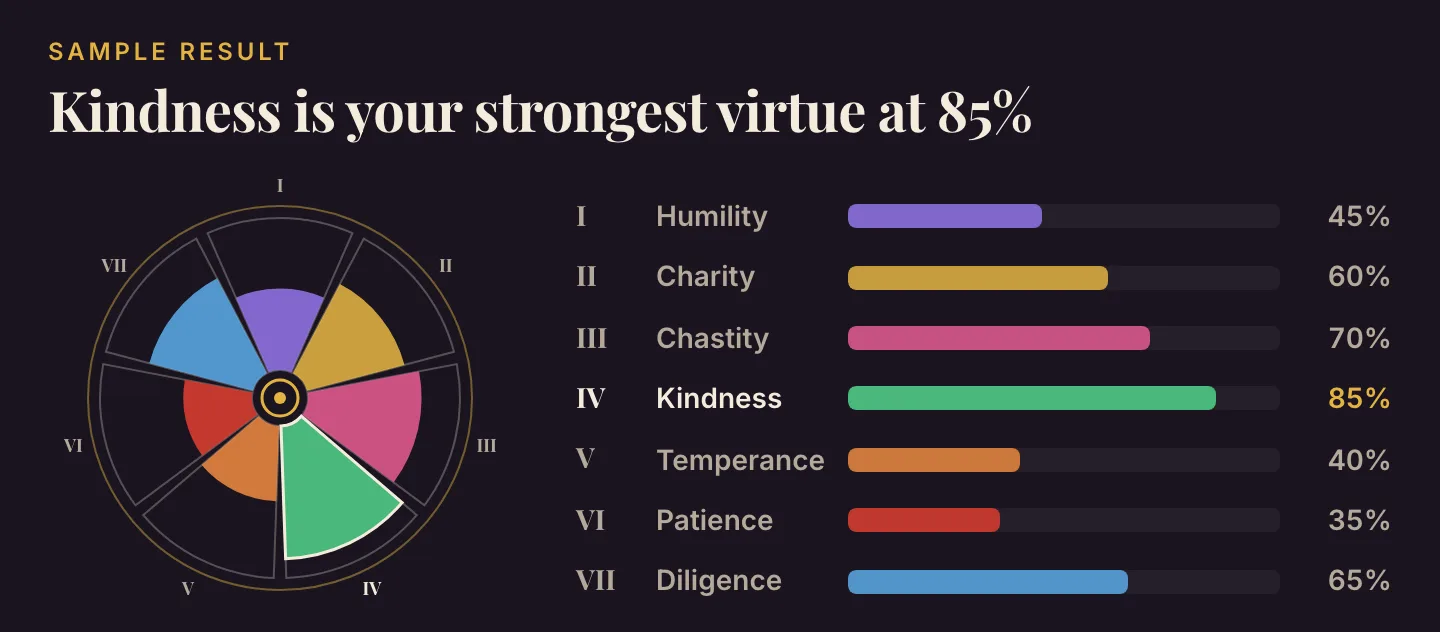
- Read your result: a wheel with one pane per virtue, seven percentages, a short reading of your strongest virtue and one thing to try for the lowest.
The whole thing takes about four minutes. If you close the tab halfway through, your place is kept in this browser, so pressing start again takes you back to the statement you stopped at.
The seven virtues this test measures
The order follows the sins they answer, from pride to sloth. Some versions of the list use other names: generosity for charity, and gratitude or brotherly love for kindness.
- I
Humility
Seeing yourself accurately: admitting mistakes, asking for help and sharing credit.
Answers pride - II
Charity
Giving money, time and attention freely, without keeping score.
Answers greed - III
Chastity
Keeping desire in proportion, and in line with your commitments.
Answers lust - IV
Kindness
Wishing other people well and being glad when things go right for them.
Answers envy - V
Temperance
Enjoying food, drink and comfort without being run by them.
Answers gluttony - VI
Patience
Bearing frustration and wrongs without lashing out.
Answers wrath - VII
Diligence
Steady, careful effort at what matters, including the dull parts.
Answers sloth
Each pair is explained in 7 deadly sins and virtues.
How the percentages are worked out
Every answer is worth 0 to 4 points: “Not me at all” is 0 and “Exactly me” is 4. Each virtue has five statements, so each one can collect up to 20 points. Your percentage is your points for that virtue divided by 20. Score 16 points on the patience statements and the test shows patience at 80%.
The seven percentages are independent. They do not add up to 100, and a high score on one virtue does not pull the others down.
The highest percentage is named as your strongest virtue. If two or more share the top spot, the result names all of them instead of picking one. The lowest is shown as the virtue with most room to grow, and that part is left out when more than two share the bottom spot.
Statements appear in a shuffled order, so the seven themes are mixed together. Once enough people have finished the test here, your result also shows what share of them had the same strongest virtue as you.
How to get an honest result
- Answer for what you actually did in the past few months, not for what you believe in. Almost everyone approves of patience. Fewer people stay calm in a slow queue.
- Go with your first reaction. If you weigh a statement for a long time, you are usually negotiating with yourself.
- Take it alone first. Answers shift when someone is watching the screen. Compare results afterwards.
- Use “Sometimes me” only when it is true. Choosing it for everything flattens all seven percentages.
A caution. A virtues quiz is easier to flatter yourself on than a sins quiz, because every statement describes something admirable. If all seven come out above 80%, a retake with stricter answers will tell you more.
Virtues test or sins test?
This site has two tests built on the same seven pairs. The 7 Heavenly Virtues Test on this page asks about the good habits. The 7 Deadly Sins Test asks about the faults they answer, using a different set of 35 statements.
The two results are not simply opposites of each other. The statements describe different situations, so you can score fairly high on patience here and still see wrath lead on the other test. Taking both shows what you already practise and where you slip.
For the other side of each pair, take the 7 Deadly Sins Test.
Which seven virtues? Two lists share the name
Search for the seven virtues and you will find two different lists. The seven heavenly virtues used in this test are the opposites of the deadly sins: humility, charity, chastity, kindness, temperance, patience and diligence. They are also called the capital virtues or the contrary virtues.
The other list combines four cardinal virtues from classical philosophy (prudence, justice, fortitude and temperance) with three theological virtues from St Paul (faith, hope and charity). Those seven describe good character as a whole and are not matched one-to-one against the sins.
The idea of virtues fighting vices goes back to the Psychomachia, a poem written by Prudentius in the early fifth century. His pairs do not match today's list exactly, but medieval preachers developed the idea into a remedy for each of the seven sins.
Questions about the 7 Heavenly Virtues Test
Is the 7 Heavenly Virtues Test free?
Yes. The whole test is free, including the full result. There is no account and no email form.
What are the 7 heavenly virtues in order?
Humility, charity, chastity, kindness, temperance, patience and diligence. The order follows the deadly sins they answer: pride, greed, lust, envy, gluttony, wrath and sloth.
Are my answers saved?
Your answers are scored in your browser and are not sent to us. Your place in the test is kept in this browser so you can come back to it. When you finish, only your strongest virtue is counted, without your name, to show how common each result is.
Is this a religious test?
No. The seven virtues come from Christian tradition, but the statements are about everyday behaviour and do not ask about belief. Anyone can take it.
What does a low percentage mean?
It means you agreed with few of that virtue's five statements. It points to a habit you practise less, not to a flaw in your character, and the result suggests one small thing to try.
Can my result change?
Yes. The test reflects habits, and habits change. A retake a few months later can look different.