7 Deadly Sins Test How the test works
How the 7 Deadly Sins Test Works
The 7 Deadly Sins Test turns 35 answers into seven percentages, one for each sin. This page explains every step: how the statements are built, how answers become points, how the percentages and the sin wheel are worked out, what happens with ties and how far to trust the result.
The short version
You rate 35 statements on a five-step scale. Each of the seven sins owns five of those statements. Your answers for a sin are added up and shown as a percentage of the maximum, so you finish with seven separate percentages and a named leading sin.
The 35 statements
Every statement describes something ordinary that people do, think or feel, written in the first person. None of them asks what you believe about sin or religion. Three examples, exactly as they appear in the test:
- “When a bill is split, I notice if I paid even slightly more than my share.” (greed)
- “A friend's good news can sting before I manage to feel happy for them.” (envy)
- “I put off important tasks until the deadline forces me.” (sloth)
The statements are shown in a shuffled order that changes every time you start, so the seven themes are mixed together and you cannot tell which sin a run of questions is building towards. All 35 are worded in the same direction: agreeing always means more of that sin.
The answer scale
Each statement has the same five answers. You can tap one, or press the matching number key on a keyboard.
- Not me at all: 0 points
- Rarely me: 1 point
- Sometimes me: 2 points
- Often me: 3 points
- Exactly me: 4 points
The next statement appears as soon as you answer. “Previous” takes you back to change an answer, and your place is kept in your browser if you close the tab.
From answers to percentages
Five statements at up to 4 points each means every sin can collect between 0 and 20 points. The percentage is your points divided by 20.
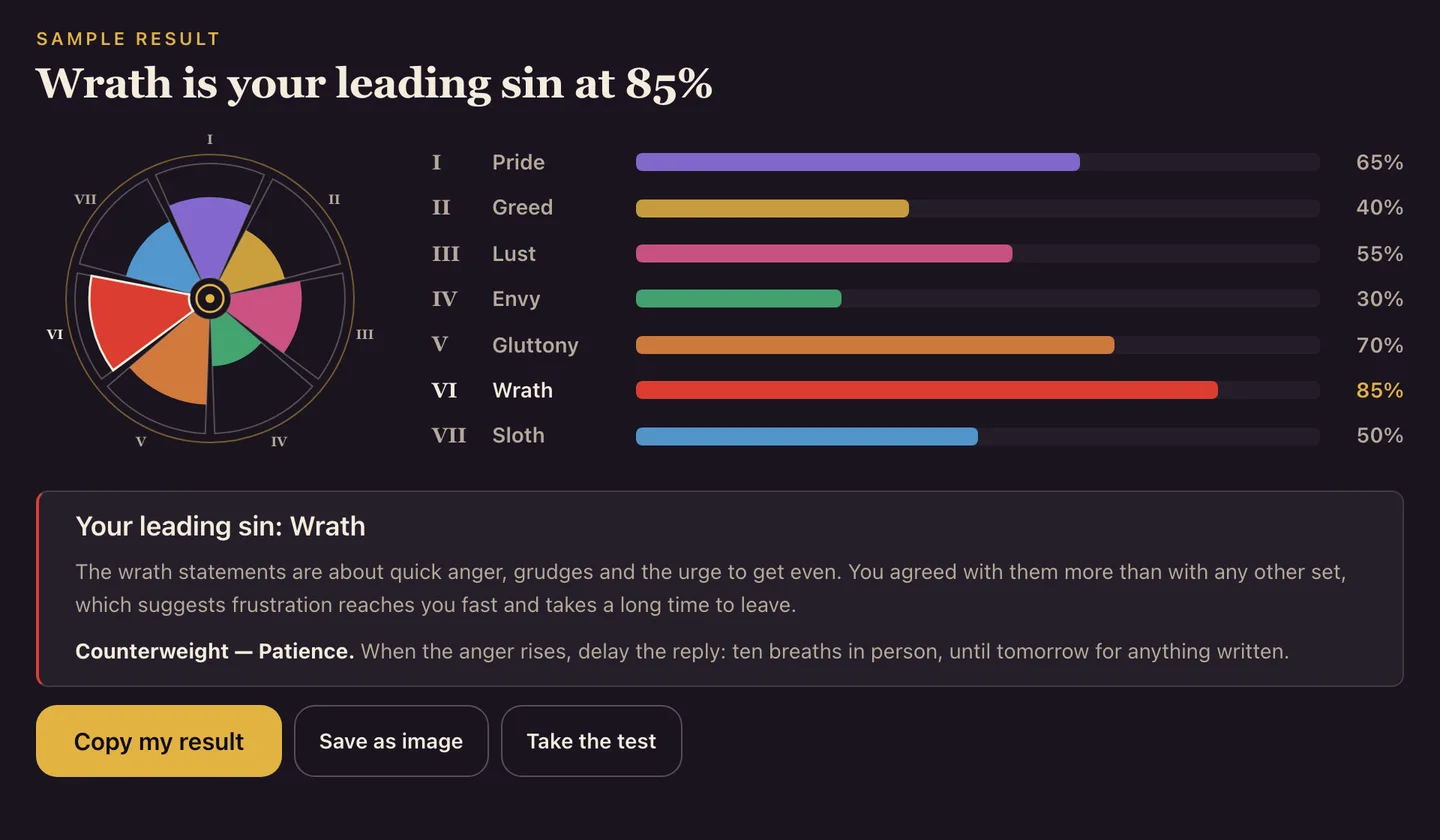
A worked example: suppose your answers to the five wrath statements are Exactly me, Often me, Exactly me, Often me and Often me. That is 4 + 3 + 4 + 3 + 3 = 17 points. Seventeen out of 20 is 85%, so the result shows wrath at 85%.
Because one answer step is one point out of 20, percentages always move in steps of five: 0%, 5%, 10% and so on up to 100%. The seven percentages are calculated separately. They do not add up to 100, and a high score for one sin takes nothing away from another.
Reading the sin wheel
The wheel on the result screen has seven coloured panes, one per sin, numbered I to VII in the traditional order starting from pride at the top. The length of a pane follows its percentage: the higher the score, the further the pane reaches towards the rim. The thin outline around each pane shows where 100% would be.
A pane never disappears completely. At 0% a short stub remains, so you can still see where each sin sits. Your leading sin is outlined in a light stroke, and the same seven numbers are listed as bars next to the wheel.
Leading sin and tied results
The sin with the highest percentage is named as your leading sin, and the result gives a short reading of it together with the virtue that traditionally counters it.
Ties are reported as ties. If two or more sins share the highest percentage, the headline names all of them and you get a reading for each. If all seven land on the same percentage, the result says so and suggests a retake with more varied answers. If every answer was “Not me at all”, every sin shows 0% and no leading sin is named.
How your result compares with other people
When you finish, the site counts one thing: which sin led your result, or that it was a tie. Your individual answers are not sent. Each browser is counted once, so retaking the test does not add more votes.
Once at least 25 people have finished the test here, results with a single leading sin show one extra line: the share of finishers who had the same sin on top. Before that number is reached, the line is left out.
How accurate is the result?
The result is an honest summary of what you told the test, and nothing more. It has three limits worth knowing.
First, it is self-report. People tend to answer a little kindly about themselves, and mood on the day shifts answers too. Second, each sin rests on only five statements, so one changed answer moves that percentage by five points. A difference of 5 or 10 between two sins is not meaningful. Third, the test has not been validated in a research study and has no reference group, so 60% does not mean “higher than 60% of people”. It means you scored 12 of the 20 available points.
Use it as a prompt for reflection and conversation. It is not a psychological assessment, a diagnosis or religious guidance.
For what each of the seven actually means, see the 7 deadly sins list.
Questions about the scoring
Why did I get two leading sins?
Because they tied. When two or more sins share the highest percentage, the result names all of them instead of picking one, and gives a reading for each.
Why are my percentages always multiples of five?
Each sin has 20 points available, and each answer step is worth one point. One point out of 20 is 5%, so every percentage is a multiple of five.
Do the seven percentages add up to 100?
No. Each sin is scored on its own scale from 0 to 100%. You can score high on several sins at once, or low on all of them.
Can I change an answer after I have given it?
Yes, while you are still in the test. “Previous” steps back one statement at a time. After the result appears, “Retake the test” starts again with a fresh shuffle.